Judo Sandan: Reflections on 3rd degree
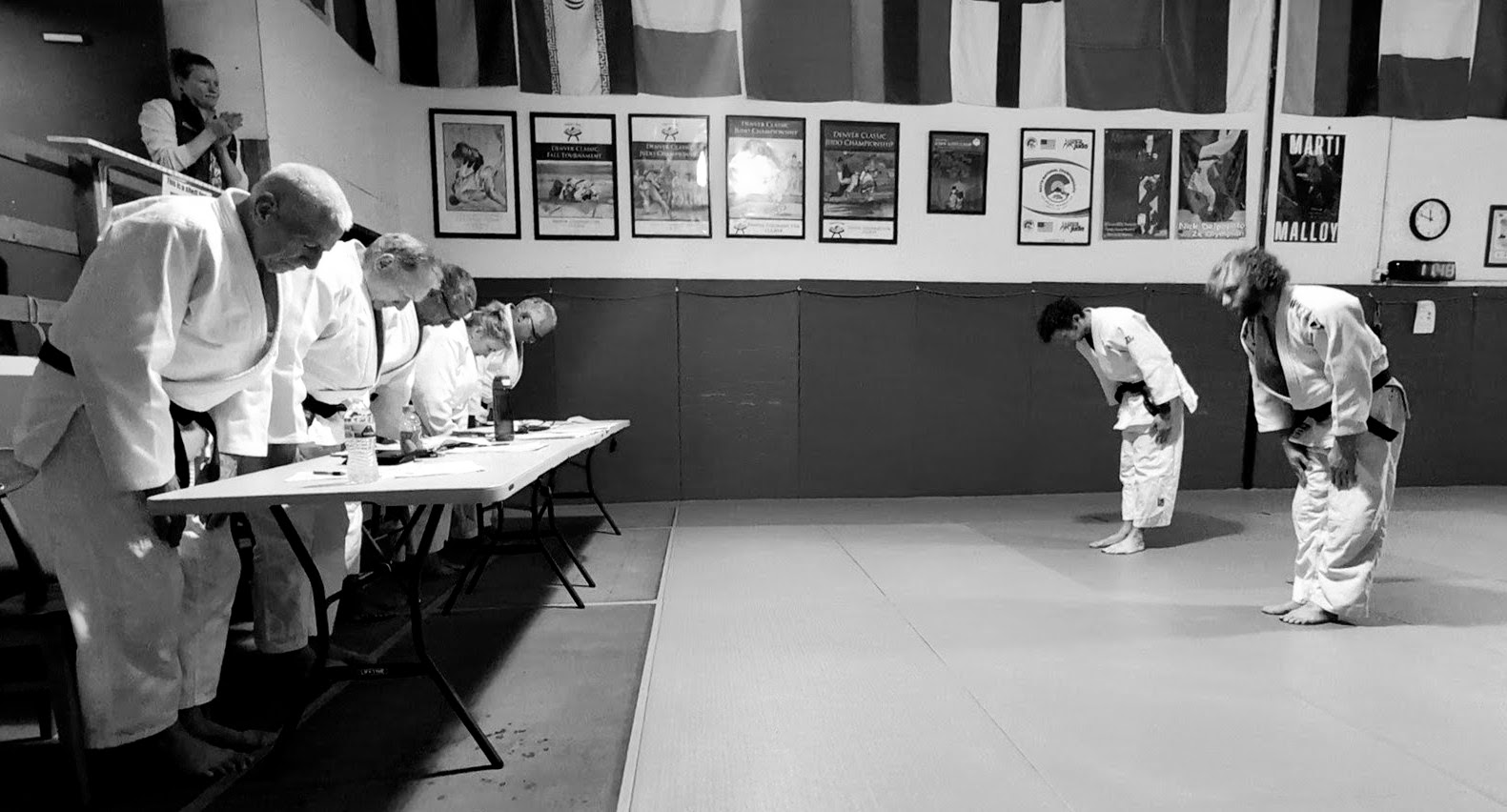
Yesterday I was promoted to Sandan. It required appearing in front of a committee; my previous Dan ranks in other states didn’t. Colorado has a more well organized Judo community. I had the great honor to watch someone get their red and white belt on the same day–69 years old, and had 700 matches in his prime back in the day.
I had an old wrestler who did 10 years of competing back in the day join my classes recently after 30 years of being off the mat. He’s enthusiastic, enjoys the newness mixed with the familiarity. But he asked me a couple classes in: what’s up with ranks? What do they really mean?
I of course have heard this come up over and over again as a discussion over the years… But I took a while to think about it and didn’t get back to him until the next time I saw him.
My conclusion? Belts vary vastly. All I can do is explain the landscape of what these can mean, and tell him what these belts take for me to earn. To some extent, these things are what you make of them. I want these ranks to mean something, so I put a lot of myself into it. But stories vary. Some do the minimum and are good at bureaucracy. Some are under ranked terribly. You always have to read between the lines.
In general, though, from the perspective of a white belt, a brown belt, a black belt, and a competition black belt are all vastly beyond him. But there are differences. I can appreciate now, at sandan, the shortcomings of my judo education that came primarily from shodans. At white belt, you lack some ability to determine that. These belts are proxy signals from above that this person probably deserves more trust. Judo is often deeply unintuitive; it takes some trust to just do what you’re told for months and years expecting it to pay off.
I never studied much for tests of any kind in my life, but I decided that at Sandan, I should begin to think of myself as accountable for the entirety of the judo curriculum, even its obscure fringes. I have students, and I don’t like the idea of them feeling expected to learn something to pass tests that I myself don’t know, the way I often felt coming up.
So I scoured the edges of the official move list, dug into history, looked into debates about nuances, practiced moves that were new to me, drilled the far reaches of the vocabulary, and so on.
Then there’s bureaucratic hoops. I did the necessary paperwork to make the gym I started more than a year ago an official USA judo gym. That also involved becoming an official USA judo coach. And that involved having a background check, taking concussion training, verifying historical rank, etc. Starting about 3 years ago I made sure to get my membership current in preparation for this.
This year I also read a biography of Kano, twice, discussing it with students (The way of Judo, which I picked carefully and greatly enjoyed, highly recommend). I purchased another book, Kodokan Throwing Techniques, by Daigo, 10th dan, to have another resource to study when I found the material online dissatisfying and not sufficient. I find myself far more appreciating the way he thinks of judo compared to the way most discuss it and understand it–far more flexibility and honesty about the reality of judo than the way I normally see judo discussed. The historical grounding is also great, though I crave even more of that. Comparing it with Mifune’s textbook (which I found a PDF of) also, makes for great deeper study in a time when most of us just go to the Internet. I’ve been satisfied with my own understanding and patchwork of knowledge I’ve picked up here and there, but to me, this is no longer enough. I want to speak with more authority, more depth of understanding, more contextual framing, a broader perspective than my own experience. I am beginning this process now; I want future ranks to represent years and decades into a journey of this level of care.
I started down this path of studying for sandan by watching all the kodokan tecnique videos, to know that I would be able to demonstrate all 100 kodokan techniques well and know them easily by name. They’re a decent starting point, but I also found several that caused me to raise an eyebrow. Seeing online that many agree with that take, I continued to watch other videos, read other discussions , but I inevitably ended up deciding it was time to reach for books that establish the authoritative basis. (I should say I also found many great articles written by some of our longtime users here!)
I also returned to competition; I used to compete a lot before COVID, but hadn’t competed since I was 29. I’m going to be 36 soon. I competed once right after getting nidan in 2019. My competition record at nidan was winning gold in 5 divisions across those 2 competitions (an open weight, 2 73kg senior divisions, a newaza division, and a veteran’s 73kg division), one comp right after getting nidan and one right before getting sandan. Every win was by ippon.
A student of mine also competed twice, getting two bronze medals and some great wins in his first year of training. More will be competing next spring. Exciting to see that unfold.
Teaching judo in other countries as I traveled, at Globetrotter camps and at gyms like Francesco Fonte’s, as well as in Costa Rica when I trained with the teens training for the national team, also went into consideration.
Could I have gotten sandan with less effort? Probably. Not every sandan will have had this same attitude towards it that I do. As I said; at the end of these days these belts are what you make of them.
But I want more than that, and making the effort to have a deep and wide understanding of judo, choosing to become an expert and mentor in this space, enables me to give more to those around me.
Going forward, I want to compete more in veteran’s divisions. Competion isn’t over after 30. I want to explore reffing more. I want to attend seminars. I want to produce national level competitors (and who knows, maybe beyond if I am so lucky). And I’d like to reach that red and white belt before I’m 50.
The minimum time in grade starts at about 20 years from today to then. That can be reduced to a further theoretical minimum of 9.5 years if you get enough points.
We’ll see what happens, but goals are fun to have.
Enjoy the ride, just thought I’d share.
Take care of each other and do the best with the life you’ve got. That’s the core lessons of judo, after all.
A short review of the test: https://www.instagram.com/reel/DSRurgijqAN/?igsh=Y28yMXE3aTlrd2R5